Cody Comyns
Mathematics & Computer Science
University of Virginia
GPA 3.94 · SAT 1560
-
2026
Resume- AI EngineerInvidia Capital Management
- Long context reasoning in LLMsUVA, Li Research Group
-
2025
- President, Phi Kappa PsiUVA
- Software Engineering Internlockchain.ai
- LLM interpretabilityUVA, Li Research Group
-
2024
- Healthcare Coverage GroupAlternative Investment Fund
- Business Development InternCyera
-
2023
- Graduated High School (top 10%)Phillips Academy Andover
- Joined the Alternative Investment FundUVA
-
2022
- tRNA engineeringYale, Söll Research Group
-
2021
- Computational biologyBrown, Rubenstein Research Group
Projects
-
Persistent Multi-Agent System
A system that can work overnight on large-scale data mining and research tasks for you.
To read more about this system, check out the following Substack article (long-form, less technical) or slide deck (short-form, more technical) explaining it.
Presentations
-
Long Context Reasoning in LLMs
An exploration of long context reasoning capabilities in large language models.

-
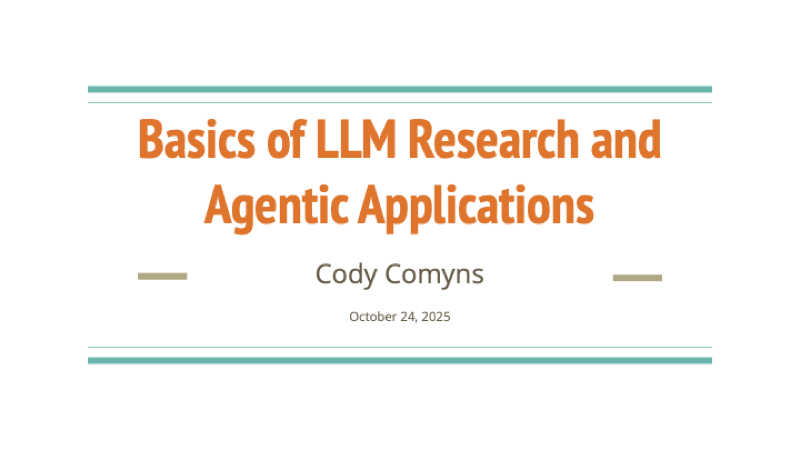
Basics of LLM Research and Agentic Applications
Foundational LLM research and the current state of AI-generated software development.
Publications
-
Deciphering the Role of Selenoprotein M
Antioxidants 12(11), 1906
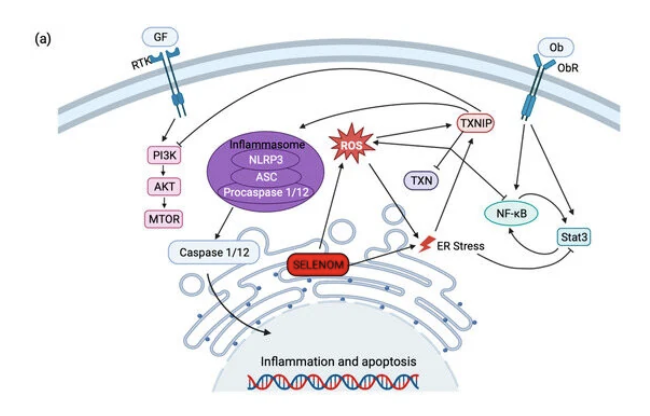
Selenocysteine (Sec), the 21st amino acid, is structurally similar to cysteine but with a sulfur to selenium replacement. This single change retains many of the chemical properties of cysteine but often with enhanced catalytic and redox activity. Incorporation of Sec into proteins is unique, requiring additional translation factors and multiple steps to insert Sec at stop (UGA) codons. These Sec-containing proteins (selenoproteins) are found in all three domains of life where they often are involved in cellular homeostasis (e.g., reducing reactive oxygen species). The essential role of selenoproteins in humans requires us to maintain appropriate levels of selenium, the precursor for Sec, in our diet. Too much selenium is also problematic due to its toxic effects. Deciphering the role of Sec in selenoproteins is challenging for many reasons, one of which is due to their complicated biosynthesis pathway. However, clever strategies are surfacing to overcome this and facilitate production of selenoproteins. Here, we focus on one of the 25 human selenoproteins, selenoprotein M (SELENOM), which has wide-spread expression throughout our tissues. Its thioredoxin motif suggests oxidoreductase function; however, its mechanism and functional role(s) are still being uncovered. Furthermore, the connection of both high and low expression levels of SELENOM to separate diseases emphasizes the medical application for studying the role of Sec in this protein. In this review, we aim to decipher the role of SELENOM through detailing and connecting current evidence. With multiple proposed functions in diverse tissues, continued research is still necessary to fully unveil the role of SELENOM.
-
Dual incorporation of non-canonical amino acids enables production of post-translationally modified selenoproteins
Frontiers in Molecular Biosciences 10, 1096261
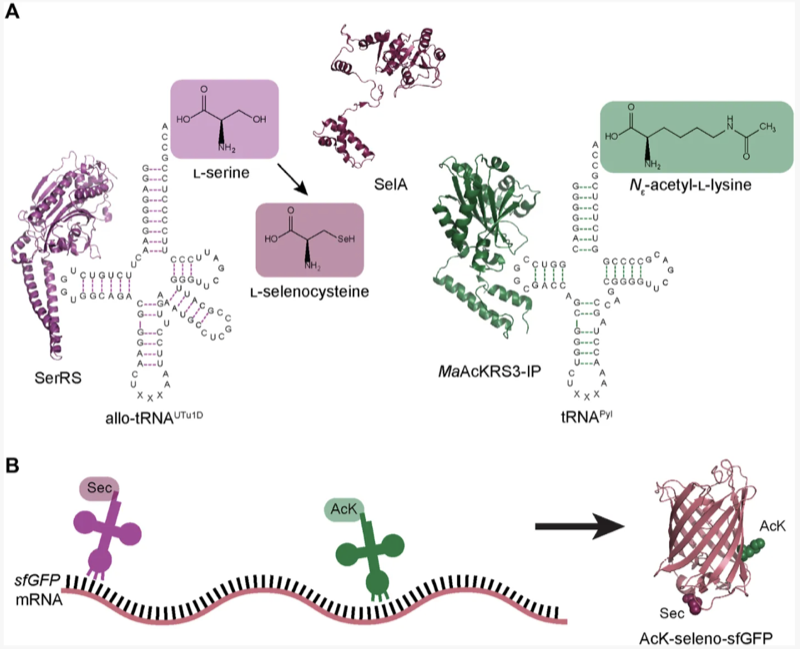
Post-translational modifications (PTMs) can occur on almost all amino acids in eukaryotes as a key mechanism for regulating protein function. The ability to study the role of these modifications in various biological processes requires techniques to modify proteins site-specifically. One strategy for this is genetic code expansion (GCE) in bacteria. The low frequency of post-translational modifications in bacteria makes it a preferred host to study whether the presence of a post-translational modification influences a protein’s function. Genetic code expansion employs orthogonal translation systems engineered to incorporate a modified amino acid at a designated protein position. Selenoproteins, proteins containing selenocysteine, are also known to be post-translationally modified. Selenoproteins have essential roles in oxidative stress, immune response, cell maintenance, and skeletal muscle regeneration. Their complicated biosynthesis mechanism has been a hurdle in our understanding of selenoprotein functions. As technologies for selenocysteine insertion have recently improved, we wanted to create a genetic system that would allow the study of post-translational modifications in selenoproteins. By combining genetic code expansion techniques and selenocysteine insertion technologies, we were able to recode stop codons for insertion of Nε-acetyl-L-lysine and selenocysteine, respectively, into multiple proteins. The specificity of these amino acids for their assigned position and the simplicity of reverting the modified amino acid via mutagenesis of the codon sequence demonstrates the capacity of this method to study selenoproteins and the role of their post-translational modifications. Moreover, the evidence that Sec insertion technology can be combined with genetic code expansion tools further expands the chemical biology applications.
Squash

I’ve played squash for just over 15 years at this point, including four years on the varsity team at Andover, which finished top 10 in the country.
Nowadays, I play a lot less squash, but if you’re interested in some match play, please reach out! I think I have 3 or 4 years left in the tank before I begin my racket sport retirement and switch to pickleball.